How ControllerAdvice Handles Exceptions
이영수|2025년 2월 10일|3분 읽기
This post covers a troubleshooting experience with ControllerAdvice.
If you find any mistakes, please let me know at joyson5582@gmail.com or in the comments 🙂
While separating @ControllerAdvice for different domains, I encountered a puzzling situation.
class AuthenticatedMemberArgumentResolver(
    override fun resolveArgument( ...){
        ...
        try {
            val memberId = tokenService.decodeToken(AccessToken(token))
            val memberData = memberService.readMember(memberId)
            return AuthenticatedMember(
                id = memberData.id,
                email = memberData.email
            )
        }catch (e:IllegalArgumentException){
            throw ResponseStatusException(HttpStatus.UNAUTHORIZED,e.message,e)
        }
}
package auth.config
@ControllerAdvice
class AuthExceptionHandler {
@ExceptionHandler(ResponseStatusException::class)
fun handleResponseStatusException(ex: ResponseStatusException): ApiResponse<Any?> {
return ApiResponse(
success = false,
status = ex.statusCode.value(),
message = ex.reason ?: "An error occurred.",
data = null
)
}
}
I implemented logic to catch exceptions during authentication and throw them as UNAUTHORIZED.
{
    "success": false,
    "status": 400,
    "message": "Invalid token format"
}
However, the result was consistently 400.
While debugging to solve the problem, I found the cause.
package lotto

@ControllerAdvice
class LottoExceptionHandler {

    @ExceptionHandler(IllegalArgumentException::class)
    fun handleIllegalException(ex: IllegalArgumentException): ApiResponse<Void> {
        logger.warn { ex.stackTraceToString() }
        return ApiResponse.fail(message = ex.message)
    }
}
Strangely, it was being caught by the IllegalArgumentException handler in a different Advice.
Now, let's investigate why this problem occurred.
Investigation
First, what happens when an exception occurs during request processing?
Our controller logic is actually executed through DispatcherServlet - InvocableHandlerMethod.
Since the exception occurred while executing the Resolver for authentication, in methodArgumentValues:
// InvocableHandlerMethod
protected Object[] getMethodArgumentValues(NativeWebRequest request, @Nullable ModelAndViewContainer mavContainer,
       Object... providedArgs) throws Exception {
           ...
           try {
                args[i] = this.resolvers.resolveArgument(parameter, mavContainer, request, this.dataBinderFactory);
            }
            catch (Exception ex) {
                // Leave stack trace for later, exception may actually be resolved and handled...
                if (logger.isDebugEnabled()) {
                   String exMsg = ex.getMessage();
                   if (exMsg != null && !exMsg.contains(parameter.getExecutable().toGenericString())) {
                      logger.debug(formatArgumentError(parameter, exMsg));
                   }
                }
                throw ex;
            }
        }
    }
}
The exception is thrown as shown.
// DispatcherServlet
protected void doDispatch(HttpServletRequest request, HttpServletResponse response) throws Exception {
    ...
    catch (Exception ex) {
        dispatchException = ex;
    }
    ...
    processDispatchResult(processedRequest, response, mappedHandler, mv, dispatchException);
}
The DispatcherServlet receives this exception and processes it.
// DispatcherServlet
protected ModelAndView processHandlerException(HttpServletRequest request, HttpServletResponse response,
       @Nullable Object handler, Exception ex) throws Exception {
        ...
        if (this.handlerExceptionResolvers != null) {
            for (HandlerExceptionResolver resolver : this.handlerExceptionResolvers) {
               exMv = resolver.resolveException(request, response, handler, ex);
               if (exMv != null) {
                  break;
               }
            }
        }
    ...
}
And it searches for an ExceptionResolver that can handle it.
// HandlerExceptionResolverComposite : HandlerExceptionResolver
public ModelAndView resolveException(
       HttpServletRequest request, HttpServletResponse response, @Nullable Object handler, Exception ex) {

    if (this.resolvers != null) {
       for (HandlerExceptionResolver handlerExceptionResolver : this.resolvers) {
          ModelAndView mav = handlerExceptionResolver.resolveException(request, response, handler, ex);
          if (mav != null) {
             return mav;
          }
       }
    }
    return null;
}
Processing is passed to the abstract class ExceptionHandlerExceptionResolver.
//ExceptionHandlerExceptionResolver
protected ModelAndView doResolveHandlerMethodException(HttpServletRequest request,
   HttpServletResponse response, @Nullable HandlerMethod handlerMethod, Exception exception) {

    ServletWebRequest webRequest = new ServletWebRequest(request, response);
    ServletInvocableHandlerMethod exceptionHandlerMethod = getExceptionHandlerMethod(handlerMethod, exception, webRequest);
}

protected ServletInvocableHandlerMethod getExceptionHandlerMethod(
       @Nullable HandlerMethod handlerMethod, Exception exception, ServletWebRequest webRequest) {
           ...
        if (handlerMethod != null) {
            handlerType = handlerMethod.getBeanType();
            ExceptionHandlerMethodResolver resolver = this.exceptionHandlerCache.computeIfAbsent(
       handlerType, ExceptionHandlerMethodResolver::new);
       }
       ...
       for (Map.Entry<ControllerAdviceBean, ExceptionHandlerMethodResolver> entry : this.exceptionHandlerAdviceCache.entrySet()) {
            ControllerAdviceBean advice = entry.getKey();
            if (advice.isApplicableToBeanType(handlerType)) {
               ExceptionHandlerMethodResolver resolver = entry.getValue();
               for (MediaType mediaType : acceptedMediaTypes) {
                  ExceptionHandlerMappingInfo mappingInfo = resolver.resolveExceptionMapping(exception, mediaType);
                  ...
                }
            }
        }
    }
}handleMethod:lotto.controller.LottoPurcahseController#purchasehandlerType:lotto.controller.LottoPurcahseControllerexception:ResponseStatusException
It retrieves a value for handling the exception from the cache or creates a new one.
The exception remains unchanged so far.
//ExceptionHandlerMethodResolver

public ExceptionHandlerMappingInfo resolveExceptionMapping(Throwable exception, MediaType mediaType) {
    ExceptionHandlerMappingInfo mappingInfo = resolveExceptionMappingByExceptionType(exception.getClass(), mediaType);
    if (mappingInfo == null) {
       Throwable cause = exception.getCause();
       if (cause != null) {
          mappingInfo = resolveExceptionMapping(cause, mediaType);
       }
    }
    return mappingInfo;
}

public ExceptionHandlerMappingInfo resolveExceptionMappingByExceptionType(Class<? extends Throwable> exceptionType, MediaType mediaType) {
    ExceptionHandlerMappingInfo mappingInfo = this.lookupCache.get(new ExceptionMapping(exceptionType, mediaType));
    return (mappingInfo != NO_MATCHING_EXCEPTION_HANDLER ? mappingInfo : null);
}
Now, for the final part 🙂
- It checks if there is a method to handle the exception type (
ResponseStatusException). - If not, it gets the
Cause. - Then, it performs recursive processing based on the
Cause. - If a matching value is found, it is retrieved.
My exception was throw ResponseStatusException(HttpStatus.UNAUTHORIZED,e.message,e).
The reason it was caught elsewhere was that the cause included IllegalArgumentException.
I wondered why it keeps using recursion based on the cause.
I think this is necessary to catch top-level exception classes like@ExceptionHandler(Exception::class).
Solution
Remove the Cause
catch (e:IllegalArgumentException){
    throw ResponseStatusException(HttpStatus.UNAUTHORIZED,e.message,e)
}
Removing e from this part solves it.
Since IllegalArgumentException is not caught in the cause, it won't be a problem.
However, this is a very dangerous method as it removes the trace of where the problem originated.
Adjusting Order with the Order Annotation
public abstract class AbstractHandlerExceptionResolver implements HandlerExceptionResolver, Ordered {The AbstractHandlerExceptionResolver that handles exceptions implements Ordered like this.
public interface Ordered {

    int HIGHEST_PRECEDENCE = Integer.MIN_VALUE;

    int LOWEST_PRECEDENCE = Integer.MAX_VALUE;


     int getOrder();
}
Spring allows adjusting the order of multiple Components through the Ordered interface.
If we make AuthExceptionHandler process before LottoExceptionHandler?
It will first process based on ResponseStatusException (without iterating to handle IllegalArgumentException).
@Retention(RetentionPolicy.RUNTIME)
@Target({ElementType.TYPE, ElementType.METHOD, ElementType.FIELD})
@Documented
public @interface Order {

    int value() default Ordered.LOWEST_PRECEDENCE;
}
And the Order annotation is what simplifies handling this Ordered interface.
@ControllerAdvice
@Order(Ordered.HIGHEST_PRECEDENCE)
Spring has a class called AnnotationAwareOrderComparator that handles this Ordered interface.
Additionally, if you specify
Orderon only one object, the order of the rest may not be guaranteed.
Conclusion
To handle comprehensive Java exceptions (IllegalArgumentException, IllegalStateException) through ControllerAdvice, it seems you need to be careful about avoiding duplicates or managing the order.
I placed AuthExceptionHandler at the highest priority because I thought it was appropriate for it to be processed first.
It seems you can control the processing method appropriately through ordering according to the actual situation.
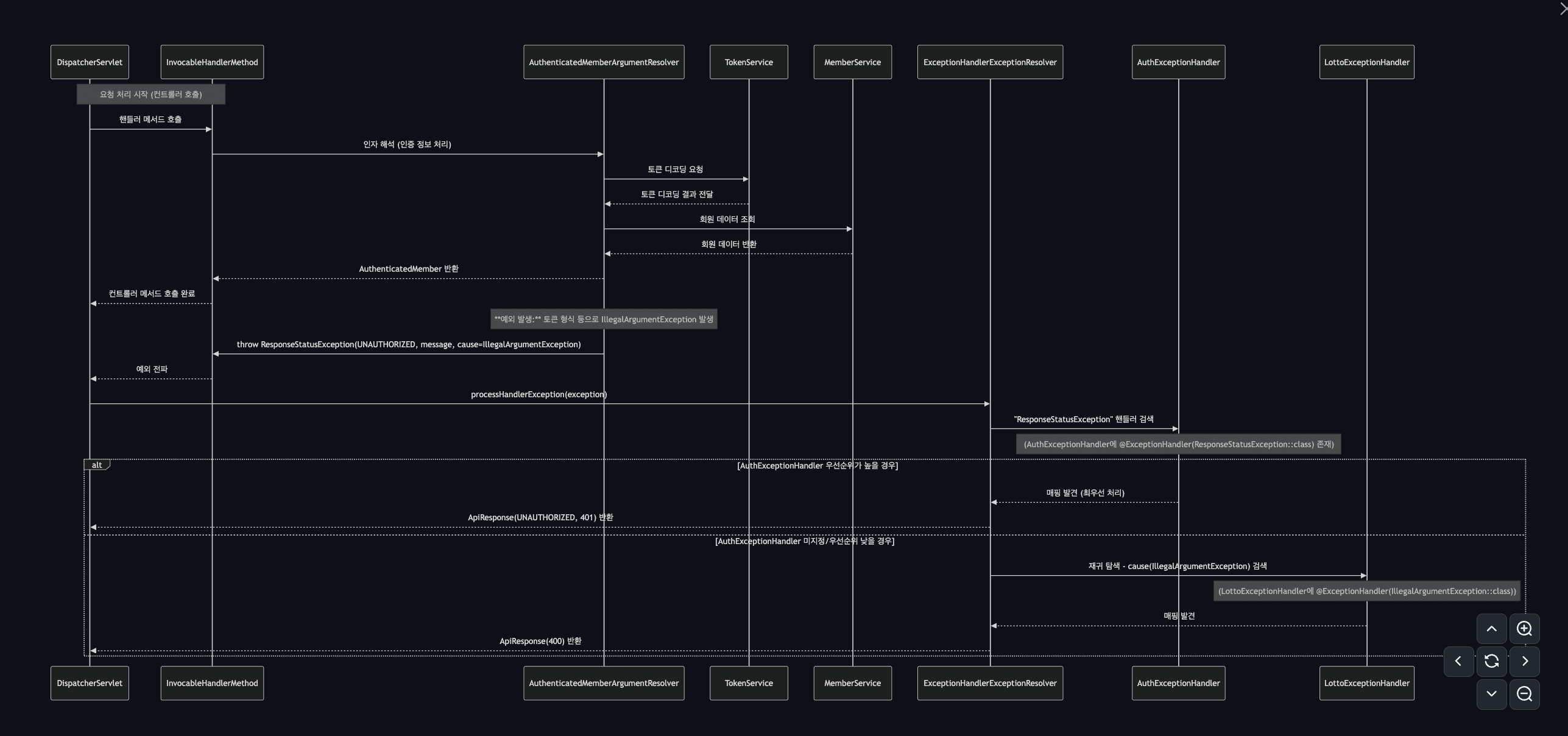
In conclusion, the content explained above seems to have this kind of flow.
Thank you for reading this long post! ☺️
空